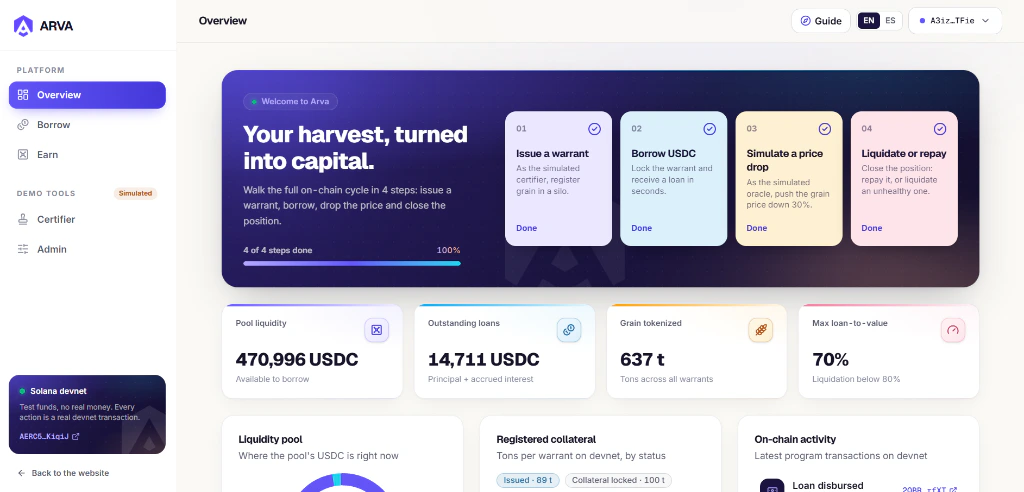
Lock your grain warrant as collateral and receive digital dollars (USDC) in seconds from an open liquidity pool. Public rules, every loan verifiable on‑chain.
A producer can have tens of thousands of dollars stored in a silo bag and still lack the working capital to start the next season. The farming calendar doesn't wait for the sale.
Credit against a warrant goes through a bank or a broker today: paperwork, manual approval and timelines that don't match the season.
The alternative is selling right after the harvest, when supply peaks and prices are at their lowest.
The warrant is regulated by Law 9,643, modernised by Decree 70/2023: electronic documents and divisible lots. Nothing new to invent.

The certifier registers the grain, the contract holds the collateral, the pool lends. No intermediaries in between.
The storage facility certifies the deposit and mints the digital warrant — one token per ton, straight to your wallet.
Deposit the warrant in the on-chain vault. The program holds it — nobody can move it, not even us.
The open pool funds your loan in the same transaction: 70% of the grain's value.
Repay anytime and the warrant returns automatically. If the price collapses, anyone can liquidate and the collateral goes to the pool.
Certified deposit of stored grain, a legal title under Law 9,643. In this demo: a test token from a simulated certifier.
Anchor program locks the warrant as collateral under public rules.
Permissionless liquidity disburses to the producer's wallet in seconds.
From a silo bag to digital dollars: how a producer unlocks capital without selling the harvest.
No fine print: these are the rules the contract enforces, the same for everyone.
Price: 350 USDC per ton, read from the simulated oracle on devnet. Interest accrues per second at the demo rate. Amounts in test USDC.
Liquidates only if soy falls below 306 USDC/t
Pick the commodity, set the tonnage and choose how much to borrow — see exactly how much USDC the warrant unlocks and where liquidation triggers.
Watch the soy price rise and crash on its own — the same math the contract runs. If the debt goes above 80% of the collateral value, anyone can liquidate it and the collateral moves to the pool treasury.
Liquidity against the grain you already have. Repay and your warrant comes back.
Put digital dollars to work in loans backed by real grain, under public rules.
The first customer is the licensed warehouse that already issues warrants. Arva gives its producers a credit product without using the warehouse's balance sheet.
Offers credit against the warrants it already issues, and keeps its producers close.
Borrows 70% of the warrant's value in seconds and gets the warrant back on repayment.
Fund the pool and earn the interest. Identified, qualified lenders first; the pool opens once the risk model is proven.
A warrant on paper needs someone to trust. A warrant on Solana carries its own rules: who holds it, how much it backs and when it's liquidated.
Lock, release and liquidation by price threshold, with no middleman and no courtroom.
Every operation is a transaction anyone can verify on the explorer.
loan_disbursed↗
warrant_locked↗
warrant_minted↗
The program holds the collateral, with the same rules for everyone.
Solana settles in seconds for a tiny fee, so even small loans make sense. In USDC, not a volatile token.
~1sconfirmation
<$0.01network fee
Banks already lend against tokenised grain. Nobody has opened up the liquidity.
Since 2022, Santander, Galicia and Grupo Petersen's banks have lent against grain tokens alongside Agrotoken. Always bilateral: one bank, one producer, one approval. Arva adds the missing layer — an open pool anyone can fund, where anyone can liquidate an unhealthy loan under public rules.
Sources: Santander press release (March 2022), Infobae, BeInCrypto.
Warrant issuance is at record highs in Argentina, yet bank credit covers only a fraction of the harvest. Meanwhile, millions of Argentines hold digital dollars that finance nothing.
in warrants issued in 2025, up 93% year over year
Argentine Secretariat of Agricultureof the value of grain output is covered by credit: about US$32 per ton
CONINAGRO, BCRA dataof agribusinesses needed credit this month; 41% postponed a decision over cost or access
Tasómetro Satowerof Argentines use crypto — the highest adoption in Latin America
Chainalysis 2025
Your own transactions read live from devnet, a review screen before every signature, a step-by-step guide and every transaction linked to Solana Explorer.
The point isn't a cheaper rate. It's money that arrives when the season needs it.
Arva is an Anchor program on Solana devnet. Warrants are SPL tokens, the pool is a program vault, and every step settles on-chain in about a second for a fraction of a cent.
Arva doesn't need a new legal figure. It builds on a 111-year-old instrument that recent reforms opened up to electronic platforms.
Creates warrants and deposit certificates over agricultural products. Still in force.
Removes restrictions and widens the products and parties covered by the regime.
Warrants can be issued and traded electronically — on issuer or third-party platforms, public or private.
Puts electronic warrants to work as open, programmable collateral. A working prototype on Solana devnet.
We'd rather say it plainly. This is a devnet demo: the money is test money, the code is real.
Real warrants certified by a licensed warehouse. The metric: the first financed warrant.
A market quote with a maximum age and its own authority, instead of the simulated oracle.
LP shares, withdrawals for lenders and a security audit.
Real USDC, only after a legal review and the steps above.

The Arva app needs the Phantom extension on a desktop browser. Open this page on your computer to try a test loan on Solana devnet.
arva-devnet.vercel.app